
Driveway gates
A driveway gate has two jobs: create the level of access control and appearance you want, and open and close reliably every time you use it. That sounds simple until the gate has to work with a sloped driveway, an unusual opening, large vehicles, existing columns, or an automatic operator.
Not just the gate
We build driveway gates for homes, rural properties, estates, farms, ranches, apartment communities, and other controlled entrances — manual, or integrated with automatic equipment and access control. Because we fabricate in-house, we can build around the actual opening instead of making a standard gate fit a property it was not designed for.
Important considerations include
- Driveway width
- Road width
- Turning radius
- Vehicle size
- Gate setback
- Property lines
- Driveway slope
- Drainage
- Available side clearance
- Fence type
- Existing columns or posts
- Manual or automatic operation
- Expected frequency of use
A gate can be technically wide enough for a vehicle and still be frustrating to use.
A trailer may need considerably more room to turn than a passenger vehicle. A gate placed too close to a narrow road may force a difficult turn. An automatic gate with too little setback may leave a vehicle waiting partly in the roadway while access is granted.
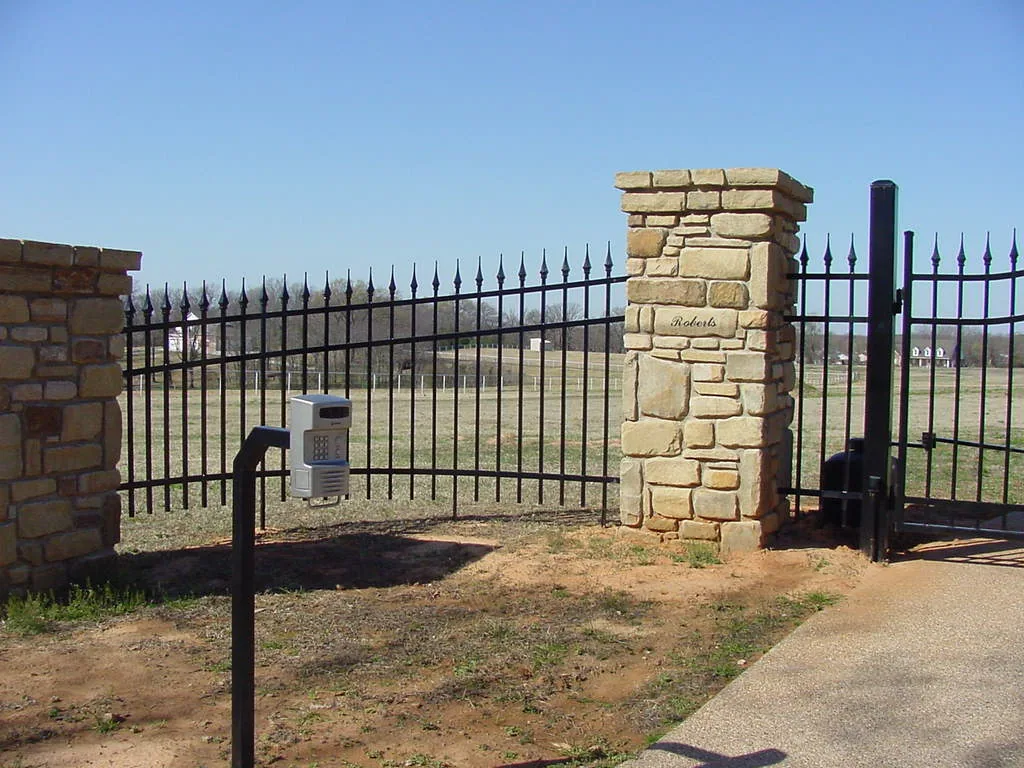
Swing, double-swing, sliding or cantilever
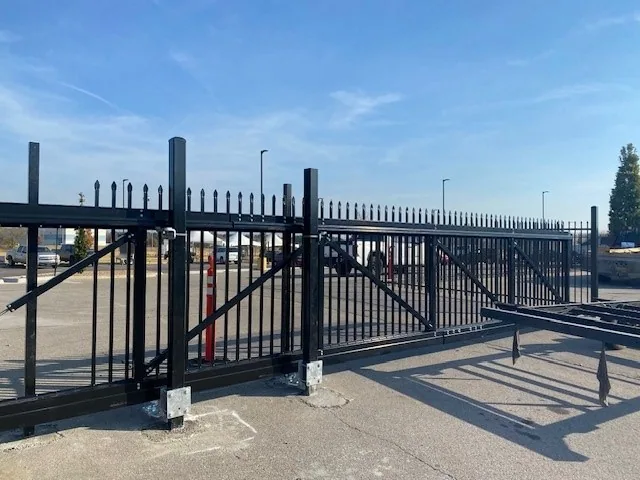
Our custom gate fabrication covers single and double driveway gates, ornamental iron gates, steel-frame gates, chain link gates, sliding gates, cantilever gates, custom hillside gates, automatic gate frames and replacement gates.
Single-swing gates
One panel across the opening gives a simple appearance, but the larger the opening becomes, the longer and heavier the gate becomes. That weight places more demand on:
- The gate frame
- Hinges
- Support posts
- Foundations
- Automatic operator, when used
Double-swing gates
Two leaves meeting near the centre reduce the width and weight each panel carries, and can be customised with ornamental details or arched profiles. The two sides still need to align properly when closed.
Sliding driveway gates
A sliding gate moves parallel to the fence instead of swinging across the driveway. It may be the better choice when:
- There is limited space for a gate to swing
- The driveway rises immediately behind the entrance
- Vehicle stacking space is important
- The property has open space beside the driveway
- Automatic operation is planned
Cantilever driveway gates
Supported from beside the opening rather than travelling on a track through the driveway. The design must account for support posts, rollers, the counterbalance section, gate frame, operator, clear travel area and surrounding fence.
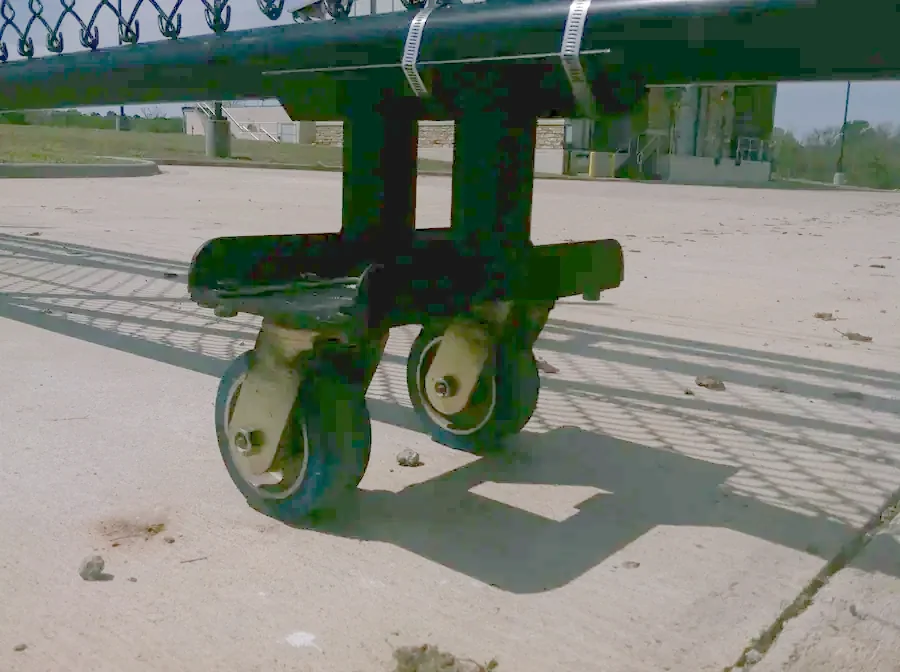
Slope is one of the most important factors in gate design
A standard square swing gate may work perfectly on level ground and perform poorly across a steep driveway. Depending on the direction of the slope, a conventional gate may:
- Drag as it opens
- Leave a large gap beneath one end
- Fail to open fully
- Reduce vehicle clearance
- Place additional pressure on hinges
- Create problems for an automatic operator
Depending on the property, the solution may involve a custom hillside gate, a different swing direction, greater gate setback, a sliding gate, or another configuration. This is one reason we fabricate gates around actual field measurements rather than standard dimensions.
A defined entrance that keeps the view
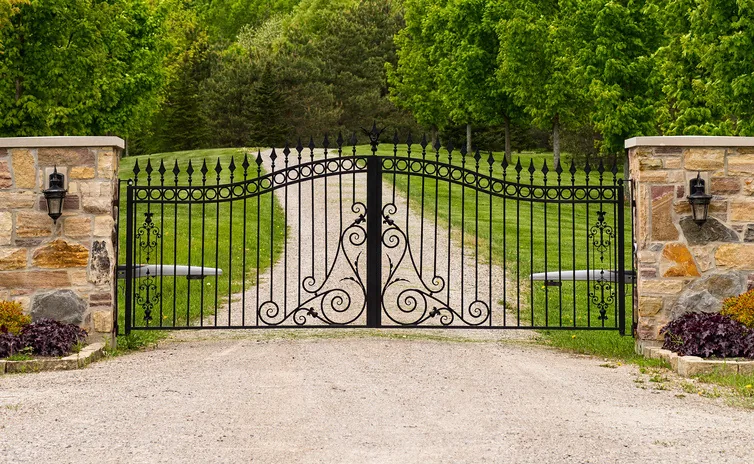
Design options may include straight-top gates, arched gates, decorative pickets, finials, scrollwork, custom posts, single or double configurations and automatic operation.
Simple designs complement modern homes; more detailed metalwork may suit traditional properties or formal entrances. The gate should still be designed first as a functioning structure — decorative details should not interfere with movement, support, access equipment, or the vehicles using the driveway.
A steel frame behind the boards
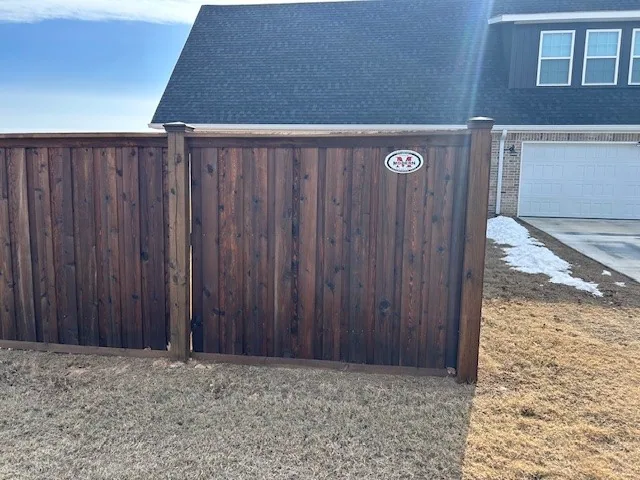
A driveway gate can incorporate wood when the property uses wood privacy fencing or the owner wants a more solid appearance. For wider openings we may use a fabricated steel frame to support the wood.
The final gate must account for the additional weight and wind exposure created by a solid surface. New wood installed on a gate may initially look different from an older fence.
The gate and the operator are one system
Automatic gates let drivers enter without manually moving the gate. The complete system may include:
- Gate operator
- Remote controls
- Keypad
- Cellular entry
- Card or RFID access
- Telephone entry
- Intercom
- Vehicle-detection equipment
- Safety devices
- Camera integration
- Solar-powered options where appropriate
A poorly aligned gate can create unnecessary strain on an operator. Gate length, weight, movement, wind exposure, expected use, power availability, and site conditions all affect the system.
A simple system can be the right system
Our access control systems provide different entry methods depending on the property — keypad, cellular, card, RFID, telephone, intercom and related options.
Consider
- How many people need regular access?
- Will guests need temporary access?
- Do service providers or contractors visit regularly?
- Does the property have more than one entrance?
- Is remote visitor communication important?
- Will user access need to be added or removed over time?
A complicated system should not be installed merely because more features are available.
The clear opening is the most important driveway-gate decision
The gate should be planned around the vehicles that use the property now and those reasonably expected in the future.
- Cars
- SUVs
- Pickup trucks
- Delivery vehicles
- Utility trailers
- RVs
- Boats and trailers
- Horse trailers
- Landscaping trailers
- Farm equipment
- Emergency vehicles
Vehicle width alone does not determine the required opening. A trailer turning from a narrow road may need considerably more room than the same trailer approaching from a wide, straight driveway.
Common driveway gate problems
- Gate sagging
- Dragging
- Failure to latch
- Broken hinges
- Bent frames
- Broken welds
- Post movement
- Vehicle damage
- Roller problems
- Poor ground clearance
- Gate leaves no longer meeting correctly
A repair may make sense when the frame, posts, and overall design remain suitable.
Replacement may be the better choice when the gate is fundamentally too light, too narrow, badly twisted, improperly designed for the slope, or repeatedly causing problems. Automatic operator and entry-equipment problems can also be evaluated separately through our access control repair service.
Our driveway gate process
1
Evaluate the entrance
We review the driveway, opening, grade, vehicle access, surrounding fence, and available gate movement.
2
Choose the configuration
Swing, double-swing, slide, cantilever, and other appropriate options based on the property.
3
Plan the design
Material, appearance, dimensions, support system, and whether automation or access control will be included.
4
Confirm measurements
Final field measurements are taken before custom fabrication.
5
Fabricate the gate
Our shop builds the approved gate and related custom metal components.
6
Install supports and gate
Posts, supports, and the gate are installed and adjusted for fit and movement.
7
Add automation
The operator, access equipment, and approved safety components are installed for automatic gate projects.
8
Final review
We inspect gate movement, alignment, clearance, hardware, and the approved operating equipment.
We have served the region since 1950, and gate fabrication is part of our core fencing operation. That matters when a driveway has a slope, unusual dimensions, existing columns, a wide entrance, or another condition that requires more than a standard gate.
Driveway gates across
Western Arkansas & Eastern Oklahoma
Our normal service area extends approximately 75 miles from Fort Smith. We may travel farther for larger or specialty projects.
Ornamental, steel-frame and sliding entrances
Visit our project gallery for completed driveway entrances, ornamental iron gates, steel-frame wood gates and automatic openings.
Do you fabricate driveway gates in-house?
Yes. We fabricate our custom gates through our own metal fabrication facility.
Should I choose a swing or sliding driveway gate?
It depends on the driveway grade, available side space, gate setback, opening width, and how vehicles use the entrance. We evaluate those conditions before recommending a configuration.
Can you build a gate for a sloped driveway?
Yes. We can evaluate custom hillside, sliding, cantilever, or other configurations depending on the direction and amount of slope.
Can my driveway gate be automatic?
Yes. Qualifying driveway gates can be designed for automatic operation from the beginning.
Can you add a keypad?
Yes. Keypads and other access-control options can be incorporated into qualifying automatic gate systems.
Do you offer telephone or intercom entry?
Yes. Telephone and intercom systems are available for selected entrances.
Can you use solar power?
Solar-powered options may be suitable for some properties. The gate, expected use, available sunlight, and equipment requirements must be evaluated.
Can you build an ornamental driveway gate?
Yes. We fabricate custom ornamental iron entrance gates with selected decorative details.
Can you build a gate between existing columns?
Yes, provided the columns, opening, support conditions, and surrounding property are suitable. We take field measurements before fabrication.
How wide should my driveway gate be?
The correct width depends on the driveway, road, vehicle sizes, turning radius, and approach angle. We recommend sizing the entrance around the vehicles that will actually use it.
Do you repair driveway gates?
Yes. We repair qualifying manual gates and can evaluate related automatic gate and access-control issues.
Do you provide free estimates?
Yes. Contact us with the property location, approximate driveway opening, gate style, vehicle needs, and whether you want automatic operation.
Tell us about the entrance
Tell us the approximate driveway width, slope, surrounding fence, largest vehicles using the entrance, and whether you are considering manual or automatic operation. If you already have entrance columns, an existing gate, or access-control equipment, let us know so those components can be considered during planning.